TOH Game Club 6 – Super Mario RPG

I was going to launch the next Tired Old Hack Game Club a month or two ago but realised that once Animal Crossing launched on Switch, everyone was going to be too busy playing that.

Now the fever has died down a tiny bit, it’s finally time to get the Game Club back up and running again. We’ve already had success with Game Clubs for Zelda II and StarTropics, followed by noticeably less success for Earthbound, Phantasy Star and Breath of Fire I & II.

But hey, now everyone’s forced to stay indoors, so you literally have ZERO excuse not to get involved this time. As long as you don’t count any legitimate excuses you may have.

Continue reading “TOH Game Club 6 – Super Mario RPG”

TOH Game Club 5 – Breath of Fire I & II

We’ve had four Tired Old Hack Game Clubs now. The first two were a success, with oodles of players joining forces to play Zelda II and StarTropics together. Then we tried with Earthbound and Phantasy Star and the numbers dropped drastically.

The formula now seems clear: folk are happy to get involved if they don’t have to spend much money (which is understandable). So, with the Switch now in possession of a growing number of SNES games, let’s go with one of those. Or two of them, as it were. Continue reading “TOH Game Club 5 – Breath of Fire I & II”

TOH Game Club 4 – Phantasy Star

The first Tired Old Hack Game Club saw loads of players joining forces to play Zelda II together. The second saw almost as many people taking on StarTropics. Then we tried Earthbound and hardly any prick showed up.

It seems clear, then, that for now we should focus on games that are readily available on the current generation of systems, particularly the Switch. So let’s try again, this time with a game that’s currently on sale at a 33% discount until 25 July.


The idea

In case you missed the first three, the Tired Old Hack Game Club is a new group in which, for a month at a time, like-minded gamers can play through retro games together.

Instead of trying to decipher a potentially troublesome retro game and figure out what makes it tick by wading your way through terrible online FAQs written by 13-year-old amateur comedians, you’ll instead be able to take comfort in the fact that a bunch of other folk are also playing through the same game as you, and you’ll be able to talk to them about it.

alis

Stuck in a particular area? Struggling to get to grips with the game’s mechanics? Found a particularly cool trick and want to share it? Have you drawn your own map to help you get through a dungeon, and you want to proudly offer it to others to help them (not that you’ll need to for this one)? This is for you.

Each time we do the Game Club, yer man Scullion will pick a retro game for everyone to play together. These will almost always be games that are easy to get hold of and affordable: I’m not going to ask you to buy an Atari Jaguar and drop £80 on Alien vs Predator or anything like that. Ideally, nothing in the Game Club will cost more than £10.

Anyone wishing to take part in the Game Club will be able to join the discussion on the Tired Old Hack Discord server. If you haven’t already joined or are new to Discord, it’s essentially just a chat room with various channels: the Tired Old Hack one has channels dedicated to the site itself, Nintendo games, Xbox games, PlayStation games, retro gaming, off-topic and the likes.

As of right this bloody moment, the Tired Old Hack Discord server also has a channel called #game-club – this is where all your Game Club discussions can take place.

If you’re interested, then, follow this link to sign up to the Tired Old Hack Discord server, and join in the conversation.

Throughout the month I’ll be jumping in to share little tidbits about the game, and post old magazine articles, be that reviews (so you can see what people thought of it at the time) or tips sections (so you can get help like we did back in the day).

The future of Game Club relies on your participation, really. If only a couple of people do it and there’s no real enthusiasm for it, then I’ll scrap it and chalk it up to experience. If, on the other hand, it results in a lovely wee community of like-minded gamers discovering classic games for the first time together, then it’ll continue for as long as possible.

That said, sign up to the Discord if you’re interested and let’s get cracking! This month’s game is:


Phantasy Star

Master System, 1987
Sega

phantasy-star-coverFinal Fantasy and Dragon Quest may be the two big RPGs people always cite, but that’s probably just because Sega’s main Phantasy Star series ended way back in 1993 (with Phantasy Star Online taking over).

The truth is, Phantasy Star was every bit as glorious as Square and Enix’s efforts, and was well loved for its weird part-fantasy, part-sci-fi setting, the fact it gave you specific characters – rather than just having you naming a generic one – and the fact that the lead protagonist was female (which was rarer back then than novels written by giraffes).

Its music is incredible, its 3D dungeon system looked incredible for the time… and it’s so bloody difficult to play in the 21st century. You see, while many of its features were genre-defining back in 1987, just as many are infuriating these days: we’ve moved on a fair bit in the past 32 years, for the better.

As such, in recent times numerous eager gamers have started Phantasy Star in the hope of seeing what all the fuss was about, and become quickly infuriated by its incredibly grindy combat, its confusing item names and its enormous maze-like dungeons.

Thankfully, these days there are now two ways to play the game. If you want the old-school challenge you can find Phantasy Star on a few modern systems (listed below). A much better way to play, though, is the new Ages Mode version of the game that can be found in Sega Ages Phantasy Star on Switch.

This improves the game in a bunch of different ways, and makes it far more accessible for today’s era. Changes include:

• less frequent random enemy battles
• more XP and money for winning each battle (to make things less grindy)
• a new menu that describes all the items, equipment and spells (which are heavily abbreviated in the game and sometimes impossible to figure out)
• best of all, the dungeons now auto-map for you: a small map on the side of the screen fills itself in as you explore. No more sitting with a pen and paper trying to figure out where you’re going.

Long story short, if you’re new to the game, this is the best way to play it now.

phantasystar3


How to get it

There are a few ways to get Phantasy Star if you fancy taking part in this month’s Game Club.

• Obviously, as described above, the best way is to buy the Sega Ages version on the Switch eShop (especially since it’s currently on sale for £4.01).

• You can get it (along with Phantasy Star II and III) in Phantasy Star Collection on the Game Boy Advance.

• It’s also an unlockable game in Sega Mega Drive Ultimate Collection on Xbox 360 and PS3 (not the recent Mega Drive Classics on Switch / Xbox One / PS4).

• Finally, if you’re dodgy, you can obviously also run it on a Master System emulator.


Starting out

Phantasy Star can be a tricky game to get into: even the very first enemies you come across will probably boot your arse until you’ve levelled up a couple of times. Stick with it, though.

Even if you’re playing through the Sega Ages version on Switch you may also want to read through the original manual.

If nothing else, it gives you a little more background to the game’s plot, and has a section dedicated to the various weapons, items and spells you’ll come across.

Here’s that Master System manual as a PDF:

Phantasy Star manual

One thing the manual doesn’t tell you, and you may end up finding out the hard way, is that there are two items you really need to complete the game: without them things will be obscenely difficult, if not impossible.

The first is the Mirror Shield, which you need to beat Medusa. To get it, you have to talk to the village elder in Sopia, who’ll tell you where it is. Then you have to travel to Motavia and find the small island there: that’s where the Mirror Shield is.

phantasy-star-2

The other is the Crystal, which is needed to severely weaken the final boss’s attacks so he doesn’t kill you with one hit. It’s in the final tower, so make sure you find it before you reach the last battle with Lassic. I recommend saving regularly so you don’t miss either of these items.

You should now have enough to get started on your adventure. When you’re ready, hop into the Discord server to begin chatting about it with your new Game Club pals: how are you finding the game so far? Have you discovered any strategies to help you in the early stages? Are you stuck and not sure where to go next?

See you in the chat!

NOTE: One final request. If you’ve already beaten Phantasy Star and fancy yourself as a bit of an expert, by all means take part in the discussions but please don’t try to become some sort of oracle of knowledge. The point of Game Club is for people who haven’t beaten the game before to experience it together: having someone give them all the answers all the time ruins the fun a bit. Besides, nobody likes a smart-arse.
TOH Game Club 3 – Earthbound

First, there was Zelda II. Then there was StarTropics. Now it’s time to go 16-bit.

The success of the first two Tired Old Hack Game Clubs meant it was only a matter of time before we did it all over again. That time is now, though I suppose that should already be obvious by this point. I mean, you knew what you were clicking.

Um… let’s go.


The idea

In case you missed the first two, the Tired Old Hack Game Club is a new group in which, for a month at a time, like-minded gamers can play through retro games together.

Instead of trying to decipher a potentially troublesome retro game and figure out what makes it tick by wading your way through terrible online FAQs written by 13-year-old amateur comedians, you’ll instead be able to take comfort in the fact that a bunch of other folk are also playing through the same game as you, and you’ll be able to talk to them about it.

Stuck in a particular area? Struggling to get to grips with the game’s mechanics? Found a particularly cool trick and want to share it? Have you drawn your own map to help you get through a dungeon, and you want to proudly offer it to others to help them? This is for you.

Each month yer man Scullion will pick a retro game for everyone to play together. These will almost always be games that are easy to get hold of and affordable: I’m not going to ask you to buy an Atari Jaguar and drop £80 on Alien vs Predator or anything like that. Ideally, nothing in the Game Club will cost more than £10.

Anyone wishing to take part in the Game Club will be able to join the discussion on the Tired Old Hack Discord server. If you haven’t already joined or are new to Discord, it’s essentially just a chat room with various channels: the Tired Old Hack one has channels dedicated to the site itself, Nintendo games, Xbox games, PlayStation games, retro gaming, off-topic and the likes.

As of right this bloody moment, the Tired Old Hack Discord server now has a shiny new channel called #game-club – this is where all your Game Club discussions can take place.

If you’re interested, then, follow this link to sign up to the Tired Old Hack Discord server, and join in the conversation.

Throughout the month I’ll be jumping in to share little tidbits about the game, and post old magazine articles, be that reviews (so you can see what people thought of it at the time) or tips sections (so you can get help like we did back in the day).

The future of Game Club relies on your participation, really. If only a couple of people do it and there’s no real enthusiasm for it, then I’ll scrap it and chalk it up to experience. If, on the other hand, it results in a lovely wee community of like-minded gamers discovering classic games for the first time together, then it’ll continue for as long as possible.

That said, sign up to the Discord if you’re interested and let’s get cracking! This month’s game is:


Earthbound

SNES, 1994
Nintendo / HAL Laboratory, Ape Inc.

By the early ’90s, the vast majority of gamers associated RPGs with fantasy settings.

They were almost always about knights, mages, princesses, dungeons, dragons and all the stuff people still moan about these days any time HBO decides to make TV shows based on them.

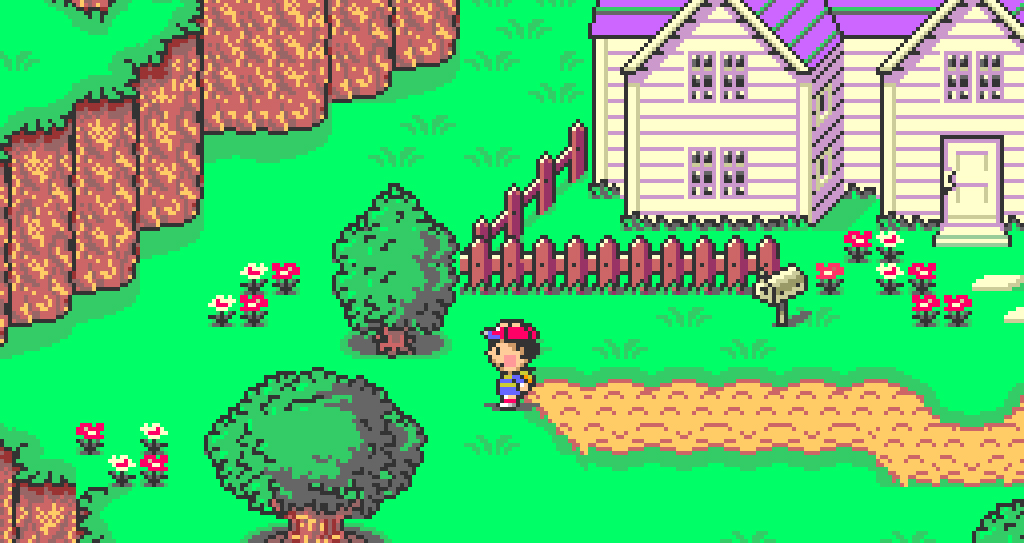
Earthbound – written by Shigesato Itoi and programmed by the late Satoru Iwata – messed with this tradition by placing an RPG story in a modern day setting, and replacing the wizards and assassins with 9-year-old children.

Earthbound was only released in Japan (as Mother 2) and North America during the SNES era: European gamers didn’t get it until nearly two decades later, when it launched on the Wii U Virtual Console in 2013.

How to get it

There are a few ways to get Earthbound if you fancy taking part in this month’s Game Club.

• It’s one of the 30 games on the SNES Classic mini console.

• You can get it on the Wii U eShop for £6.99 / $9.99.

• You can get it on the New 3DS eShop for £8.99 / $9.99 (only if you have a New 3DS model).

• Finally, if you’re dodgy, you can obviously also run it on an SNES emulator.

Starting out

Earthbound is a fairly typical example of a mid ’90s RPG, so if you aren’t familiar with that genre it may take you a little while to get used to its start-stop flow.

In fact, if that’s the case you’re going to have a more authentic experience: when Earthbound launched in the US, many gamers of that era were in the same boat because the RPG genre was still struggling to find the massive fanbase it had in Japan.

To make up for this and make sure players were able to get to grips with it, Nintendo actually included a huge 130-page strategy guide with the game, which players could consult any time they needed a hint.

Naturally, I’m the generous type, so here’s that entire guide in PDF form:

Earthbound Strategy Guide

Try not to rely on it too much, mind: that guide was designed for complete newcomers to the RPG genre and so it holds their hand through almost the entire game. By all means read the first few pages to get an idea of what’s going on, but reading any more will essentially be the equivalent of playing with a walkthrough. Instead, get involved with your fellow gamers: that’s what Game Club is for, after all.

What I do recommend, though, is the ‘Earthbound at a Glance’ section at the back of the book: this is a really useful guide that explains what every item in the game does.

You should now have enough to get started on your adventure. When you’re ready, hop into the Discord server to begin chatting about it with your new Game Club pals: how are you finding the game so far? Have you discovered any strategies to help you in the early stages? Are you stuck and not sure where to go next?

See you in the chat!

NOTE: One final request. If you’ve already beaten Earthbound and fancy yourself as a bit of an expert, by all means take part in the discussions but please don’t try to become some sort of oracle of knowledge. The point of Game Club is for people who haven’t beaten the game before to experience it together: having someone give them all the answers all the time ruins the fun a bit. Besides, nobody likes a smart-arse.
TOH Game Club 2 – StarTropics

Well, I think it’s fair to say the first Tired Old Hack Game Club was a success. Well over a hundred people joined throughout the course of the month to take part in a Zelda II playthrough, helping each other out along the way.

Many even finished the game for the first time, commenting that were it not for the Game Club they probably wouldn’t have managed it. Which is lovely to hear.

With that in mind, let’s do it all over again. Continue reading “TOH Game Club 2 – StarTropics”

TOH Game Club 1 – Zelda II: The Adventure Of Link

There once was a time, long before the days of the internet, when groups of friends would gather in playgrounds all over the world and discuss the games they were playing.

I grew up having daily lunchtime chats with my pals about the big game of the moment, sharing secrets and offering advice to each other along the way.

I told one of my pals about the warp zone in the whale area in Super Mario Bros 2. He told me how to solve the Deborah Cliff puzzle in Castlevania II (he got it from a magazine: there’s no way we’d have figured it out otherwise).

That sense of camaraderie is still there to an extent these days: when new games are released, they’ll enjoy the spotlight on Twitter for a week or so while people share screenshots and clips of stuff they’ve done.

Retro games, though, no longer get to enjoy this. Because the emphasis these days is on playing the big new games on day one because of the old FOMO issue, anyone trying to discover an old game for the first time will most likely be doing so on their lonesome.

It’s a shame, because older games are often the ones that most need to be discussed with others. In the days before hand-holding was commonplace and many games became about simply running to the next flashing point on your map, 8-bit and 16-bit games were regularly happy to leave you in the dark and make you figure it out yourself.

I miss the days when friends would come together and share their experiences, their advice and their enthusiasm for the purposes of helping each other out, rather than to try and get likes on Twitter. So I’m trying to get those days back.

Welcome to the Tired Old Hack Game Club! Continue reading “TOH Game Club 1 – Zelda II: The Adventure Of Link”